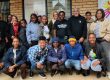
I acknowledge the Timol family: Mohammed Timol, Imtiaz Cajee and other family members whose refusal to let go is the reason we are able to have this conversation today. I acknowledge Dr Salim Essop, Dr Dilshad Jetham and others who went back into the memory of that building so that a court could hear what happened inside it. I acknowledge the Ahmed Kathrada Foundation, the teachers and learners of the Ahmed Timol School, and all of you who have come to remember.
1. The lie, and the family that refused it
On 27 October 1971, Ahmed Timol, a 29-year-old teacher, fell from the tenth floor of John Vorster Square. We will stand outside the wing of that building later this morning.
The Security Branch told the country he had jumped. In 1972 a magistrate agreed: finding it was suicide, and that nobody was to blame. It emerged during that inquest that the officers even had a joke about it: “Indians can’t fly.”
The Timol family lived under that finding for more than four decades. They were harassed and abused. Mohammed Timol was himself detained, tortured and banned and eventually driven into exile. And still the family did not accept the lie.
The 2017 inquest was an historic event, but it was made by people: a family that would not stop, and detainees who agreed to re-live their horrors in open court. The late George Bizos appeared in both inquests, 46 years apart. He was counsel for the family in the 1972 inquest and in 2017 he was one of our witnesses.
2. What the court found
In June 2017 the High Court reopened the inquest, the first time for an apartheid era case. The inquest did 2 important things: it uncovered the truth and it restored the family’s dignity.
First, the truth. Timol did not jump. He was viciously tortured in room 1026 and then pushed from the roof of JVS, while in the hands of his interrogators. The court found he had suffered some thirty-five injuries before he fell and was probably unconscious at the time.
The police likely murdered him to avoid having to explain his terrible state. Their conduct amounted to murder. It held the two lead interrogators, Gloy and Van Niekerk responsible. It found that the Security Branch’s star witness, Rodrigues, had told a fabricated story, and that the whole investigation was a cover-up, ably assisted by selected members of the prosecuting authority, the medical profession and the courts.
Of some thirty Security Branch members involved, only three were still alive. That is what delay does to justice. The truth was recovered, but late, and at a price.
Third, dignity. The 1972 finding described Timol as “an Asian male.” Judge Mothle refused to repeat it. He restored to Ahmed Timol what apartheid had stripped from him, even in death, and recorded him as what he was: a South African citizen and a man who stood up to tyranny.
3. The door that opened
The judgment did something else that mattered as much as its findings. It showed that there were no time limits on murder and other atrocities. A finding of suicide, entered by a magistrate in the apartheid years, can be reopened half a century later if new evidence is brought. And judge Mothle went further. He said that other families were waiting for closure, recommended that they be assisted to reopen their cases, and urged that the records must be preserved.
Families heard that. Since 2017, reopened inquests into the deaths of Neil Aggett, Dr Hoosen Haffejee and Imam Haron have each reached very different findings from the original findings. In September 2023, Judge Nkosi found that Dr Haffejee had been tortured and killed by the Security Branch. A few weeks later, Judge Thulare found that Imam Haron had been tortured to death.
Crimes against humanity charges, including Apartheid as a crime against humanity have been included in the Cosas Four charge sheet.
And since June 2025, a third inquest into the murder of the Cradock Four has been running before Judge Beshe in Gqeberha, who in June this year ordered the release of hundreds of classified secret military documents. Just two weeks back an inquest into the brutal murders of the Pebco Three started in the High Court in Gqeberha.
The NPA has told the Khampepe Commission that, by March 2025, 157 TRC cases were under active investigation. Timol was not the end of a story. It was the proof that the story could be reopened.
4. The door opened late
But I would be failing you if I left it there. An honest reflection on Timol must include a reckoning with what was lost.
Imtiaz Cajee had gone to the NPA in 2003. It took 14 years of struggle, the painstaking investigations of private investigator the late Frank Dutton, support from Yasmin Sooka and the Foundation for Human Rights and a determined family to get the inquest reopened.
Van Niekerk died in 2006. Gloy died in 2012. They escaped justice.
Rodrigues was held to account in the inquest, and he was charged with murder in 2018. He tried to stop the prosecution. Both the High Court and the SCA rejected that attempt. Both courts recorded that there had been significant interference with the work of the NPA, and it called for an investigation. Rodrigues died in 2021, before he ever stood trial. By the time the NDPP overturned the refusal of the DPP to prosecute former SB officers Els and Sons for perjury, key witnesses were no longer available.
When we wrote the family’s heads of argument in 2017, we called the neglect of the TRC cases inexcusable, and we said it pointed to a design on the part of the authorities to let the perpetrators of the past escape a reckoning. Today this is the subject of a judicial commission of inquiry.
5. The Khampepe Commission and the claim for constitutional damages
In January 2025, twenty-five survivors and family members, among them the families of the Cradock Four, Nokuthula Simelane, Imam Haron and Dr Haffejee went to the High Court. They asked it to declare that the failure to investigate and prosecute the TRC cases violated their rights to dignity, equality and the rule of law. They asked for constitutional damages. And they asked for an independent commission of inquiry.
The damages they seek are not a windfall. They are to fund inquests, private prosecutions, commemoration, memorialisation and public education. It has to be asked why the President and government are fighting this case tooth and nail.
In May 2025, after negotiations, the President established the Commission, chaired by retired Justice Sisi Khampepe. It has now sat for most of this year. It has heard prosecutors, police generals, ministers and former heads of the NPA and last Monday it heard from a former president.
The Commission has made no findings as yet. What I will say is that the Timol story tells us which questions to ask. Who decided that these cases would wait? Who benefited from the waiting? And why was it left to families to do what the state was obliged to do?
6. What we owe
Let me close with four things that I believe follow from Timol:
- First, the records. The state must secure and open its archives: police, prosecution, defence force and intelligence.
- Second, prosecutions must follow wherever they are still possible.
- Third, support for the families. In 2017 the court said families should be helped and not left to fight alone.
- Fourth, memory. In 2017 the Timol family asked for a memorial where Ahmed fell, a wall of remembrance bearing the names of all who died in detention, and the tenth floor restored as a place of education. Memory cannot be left to anniversaries. It has to be built.
And one more thing. In his recommendations, Judge Mothle called on every branch of the state to develop a “culture of intolerance” to human rights violations.
In our heads of argument, we warned that torture in police custody did not end in 1994. Remembering Timol is not only about the past. It is about what we tolerate now.
Ahmed Timol was a teacher. The lesson of these fifty-five years is a teacher’s lesson: truth is slow, but it can be recovered, — if people refuse to let go of it.
Thank you.